
2026-06-25
A Rapidly Expanding Computing Network Set to Create Millions of Jobs
Source:Xinwen Lianbo (Official WeChat Account)
The rapid expansion of artificial intelligence (AI) is fueling an exponential surge in demand for computing power. The question is how to make computing power as accessible and user-friendly as utilities such as water and electricity.
A nationally integrated, interconnected computing power network is gradually taking shape.
Data centers are being built at scale to meet surging demand for computing power.
Alongside the rapid growth of domestic large language models and AI agents, tokens, the smallest units of information processing in large language models, have seen their average daily usage in China increase more than 1,400-fold over the past two years, with growth further accelerating this year.
The majority of the one thousand AI companies driving this demand are concentrated in eastern China. Meanwhile, five of China’s eight national computing hubs under the “East Data, West Computing” initiative are located in the western region, where abundant wind and solar resources help reduce computing costs.
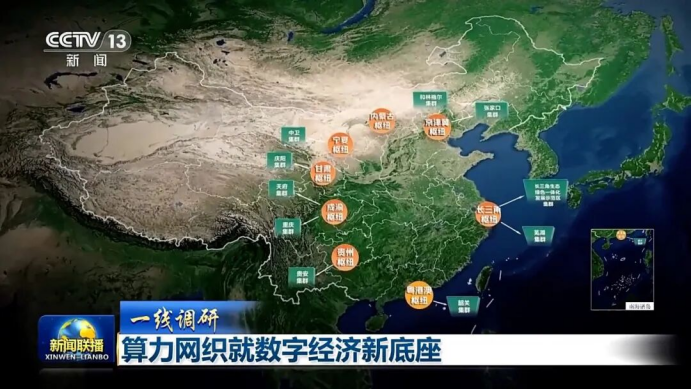
How can computing hubs in western China meet the surging demand for computing power from the east?
In the Horinger New Area of Hohhot, Inner Mongolia, one of the data center clusters under the “East Data, West Computing” initiative, more than 30 data centers are currently under construction within a three-kilometer radius.
In Zhongwei, Ningxia, another wave of intensive data center construction is also underway. New facilities are being built with significantly higher ceilings. According to on-site workers, the standard floor height for server rooms used to be around five meters; it has now increased to about 7.5 meters.
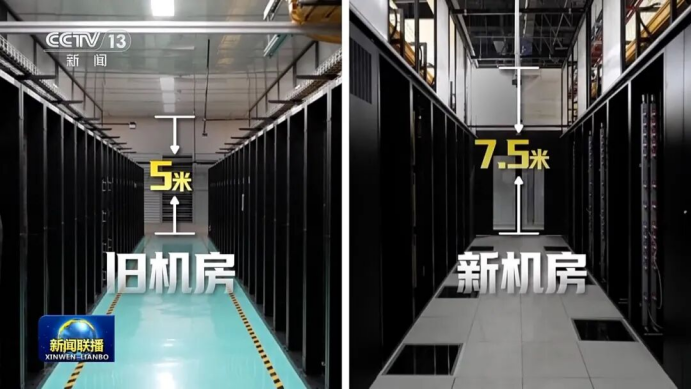

According to Yin Xiaohui, head of technology at China Unicom’s Zhongwei Cloud Data Center, the facility has been specifically designed for AI computing servers. The overhead cable routing space has been significantly expanded, as these systems require more than 200 times the number of optical fibers compared with traditional servers.
As optical fiber networks grow denser along high-speed rail lines, the foundation of the national computing infrastructure is being steadily strengthened.
Across the country, computing nodes of all sizes are undergoing their largest capacity expansion in years. However, new challenges have emerged: the optical fiber networks used to transmit computing resources between eastern and western regions are struggling to keep pace with the rapid growth in computing capacity.
Along a newly constructed high-speed rail line, a backbone optical cable is being installed, marking the first time such a line will traverse the Qinling Mountains along an east-west route over such a long distance. The black fiber-optic cables are being neatly laid into grooves beside the tracks. The new-generation cables offer 16 times the transmission capacity of their predecessors.

According to Yao Zhiyong, chief commander of China Telecom’s Xi’an-Chongqing trunk optical cable project, fiber deployment in the past typically followed national highways. Today, however, it is increasingly being deployed alongside high-speed rail lines.
The “New Eight Vertical and Eight Horizontal” backbone optical cable network is now rapidly expanding along China’s high-speed rail lines. Around computing hubs and data center clusters under the “East Data, West Computing” initiative, connectivity is expanding and becoming increasingly dense. A number of emerging “computing power cities” are achieving, for the first time, direct high-speed backbone fiber connectivity. This increasingly dense fiber-optic network is laying a solid foundation for the development of computing infrastructure.

A unified national cloud computing system is making computing power as accessible as water and electricity.
With the foundational infrastructure in place, how can we ensure that diverse computing resources are seamlessly deployed across it?
At Peng Cheng Laboratory in Shenzhen, Guangdong Province, a scientific research “task force” is working to transform fragmented computing centers into a unified national cloud computing system. In the future, powered by a nationwide computing network, the efficiency of AI services across society will increase a thousandfold.
Yu Yue, a researcher at Peng Cheng Laboratory, explained that a command-and-control center is being developed for large-scale computing tasks, enabling any type of computing demand to be seamlessly scheduled and executed across the network. In this way, computing power can truly become a foundational utility, much like water and electricity.
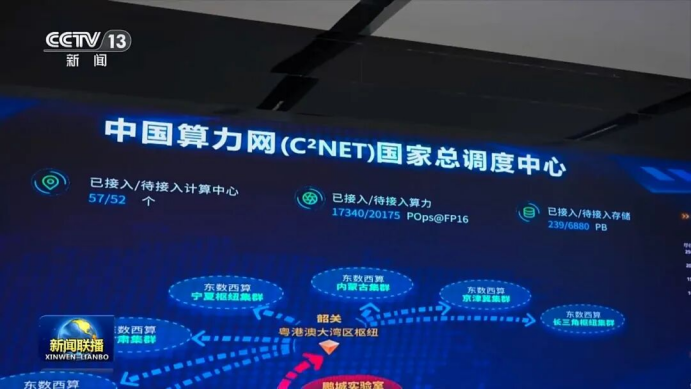
Today, an invisible computing network is rapidly taking shape. It is ushering in a trillion-yuan-scale investment cycle and driving rapid growth in industries such as optical communications and AI servers. From computing infrastructure operators to AI model trainers, new job opportunities are emerging, with the potential to create millions of jobs.
Source: Xinwen Lianbo (Official WeChat Account)
