
2026-09-17
Seven Government Departments Unveil New Measures on AI, Computing Infrastructure and More
Source:CCTV Finance and Economics Channel (CCTV-2)
Recently, seven government departments, including the Cyberspace Administration of China, the National Development and Reform Commission, the Ministry of Industry and Information Technology, the Ministry of Ecology and Environment, the Ministry of Housing and Urban-Rural Development, the Ministry of Agriculture and Rural Affairs, and the Ministry of Commerce, jointly issued the Implementation Plan for Promoting Coordinated Digital and Green Transformation (2026–2030) (hereinafter referred to as the Implementation Plan). The plan outlines the overall approach, objectives, key tasks, and policy measures for advancing coordinated digital and green transformation during the 15th Five-Year Plan period.
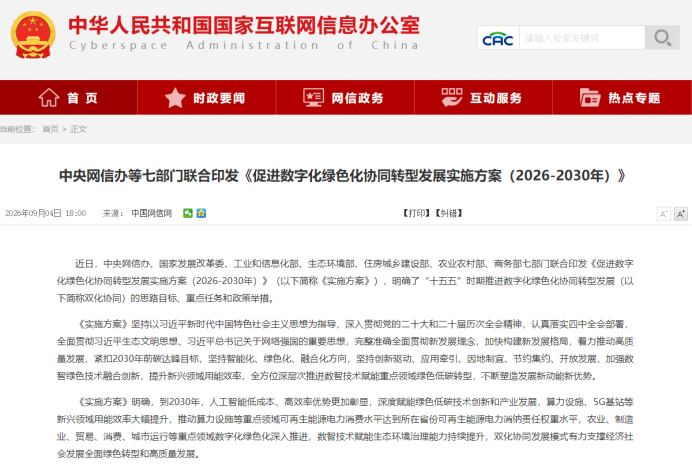
Guided by Xi Jinping Thought on Socialism with Chinese Characteristics for a New Era, the Implementation Plan follows the guiding principles of the 20th National Congress of the CPC and the successive plenary sessions of the 20th CPC Central Committee, and implements the decisions and arrangements of the fourth plenary session of the 20th CPC Central Committee. It also fully incorporates Xi Jinping Thought on Ecological Civilization and General Secretary Xi Jinping’s important thoughts on building China into a cyber power. The plan calls for the full and faithful implementation of the new development philosophy, accelerated efforts to foster a new development paradigm, and a strong focus on promoting high-quality development. It aligns closely with the goal of achieving carbon peaking by 2030 and promotes intelligent, green, and integrated development. It emphasizes innovation-driven development, application-driven approaches, adapting measures to local conditions, efficient and intensive resource utilization, and open development. It calls for stronger integrated innovation in digital and green technologies, improved energy efficiency in emerging sectors, and the deeper application of digital and intelligent technologies to support green and low-carbon transformation in key areas, thereby creating new drivers of development and strengthening new competitive advantages.
The Implementation Plan states that by 2030, AI’s advantages in cost-effectiveness and efficiency will become increasingly evident, driving innovation in green and low-carbon technologies and industrial development. Energy efficiency in emerging sectors such as computing infrastructure and 5G base stations will be significantly improved. Renewable electricity consumption in key areas, including computing infrastructure, will be raised to meet the renewable energy consumption responsibility targets of their respective provinces. By then, digital and green transformation will be further advanced in key sectors, including agriculture, manufacturing, trade, consumption, and urban operations. Digital and intelligent technologies will continue to enhance ecological and environmental governance capabilities, while a model of coordinated digital and green transformation will provide strong support for a comprehensive green transition of economic and social development and for high-quality development.
The Implementation Plan sets out 14 key tasks in four areas to achieve the development goals for the 15th Five-Year Plan period.
First, it calls for promoting integrated innovation in digital and green technologies, developing green and energy-efficient AI technologies, and leveraging AI to drive innovation in green and low-carbon technologies.
Second, it aims to improve energy efficiency in emerging sectors by promoting the green and low-carbon development of computing infrastructure, telecommunications base stations, and digital enterprises.
Third, it seeks to advance coordinated digital and green transformation across key sectors, promoting digital and green development in areas such as agriculture, manufacturing, trade, consumption, and urban operations, while enhancing intelligent capabilities in ecological and environmental governance.
Fourth, it focuses on strengthening the foundations for coordinated digital and green transformation by optimizing the development environment, improving digital carbon management capabilities, and deepening international exchanges and cooperation.
Source: CCTV Finance and Economics Channel (CCTV-2)
